Introduction
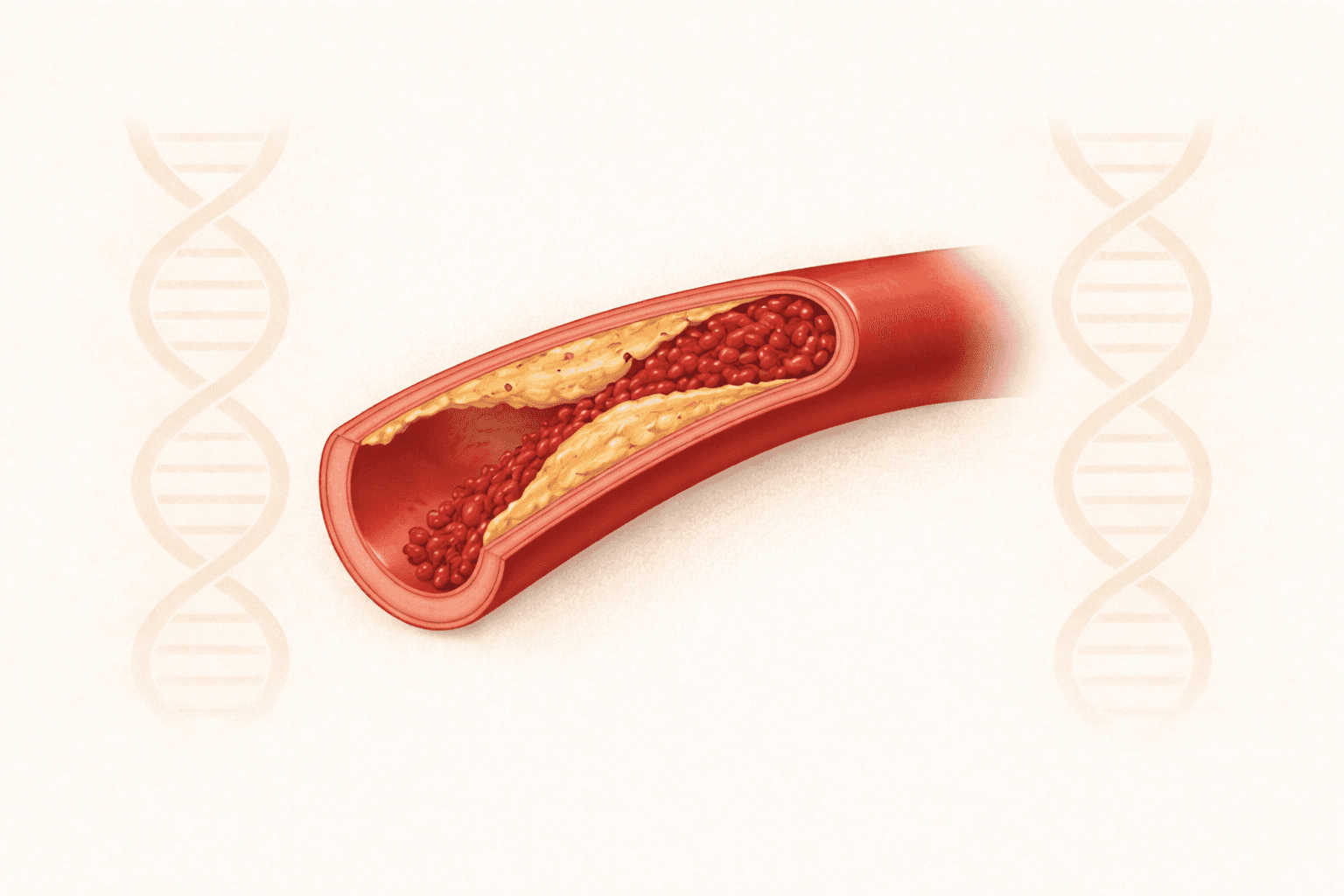
Coronary artery disease (CAD) is the narrowing or blockage of the coronary arteries, most often caused by plaque buildup (atherosclerosis). Risk factors include smoking, alcohol use, poor diet, inactivity, and hypertension. Symptoms include chest pain, fatigue, and, in severe cases, heart attack.1 CAD is the leading cause of premature adult death worldwide, accounting for approximately 7.4 million deaths in 2015.1 A US study estimates a 27% lifetime risk of developing the disease.2 Treatment typically involves a combination of lifestyle modification, management of blood pressure and diabetes, and medications to lower LDL cholesterol. Common lifestyle interventions include dietary changes, increased physical activity, and smoking cessation.1
Genetic Risk Score
CAD is shaped by both environmental and genetic factors. Monogenic testing is not available because no single gene causes the condition. Genetic risk scores (GRS), which combine the small effects of many variants into a single score, are currently the only way to estimate genetic risk. Although not diagnostic, a GRS can indicate how likely an individual is to develop the disease.
Orchid’s CAD GRS was trained following current industry standards.3,4 The GRS was constructed using the SBayesRC algorithm trained on publicly available FinnGen and Million Veterans Program summary statistics.5,6 The summary statistics include 152,517 cases and 929,037 controls.7 The resulting GRS contains over a million variants.
Risk predictions are adjusted to each individual’s ancestry, with predictive power decaying as genetic distance from the predominately European training data increases.8 Orchid considers a GRS meaningfully predictive if individuals at roughly the 97.7th percentile have an odds ratio (OR) of at least 2. The CAD GRS meets this criterion for all common ancestry groups.
Evaluation on UK Biobank Data
We evaluated the predictive accuracy of Orchid’s CAD GRS using the UK Biobank (UKB), a research database of roughly 500,000 genotyped individuals from the United Kingdom.9 We restricted the analysis to participants of British ancestry and defined CAD using the I25.1 ICD-10 code, yielding 27,972 cases and 380,548 controls (6.8% prevalence). We then grouped individuals by GRS percentile and compared the observed disease prevalence within each group to our model’s predictions (Figure 1).
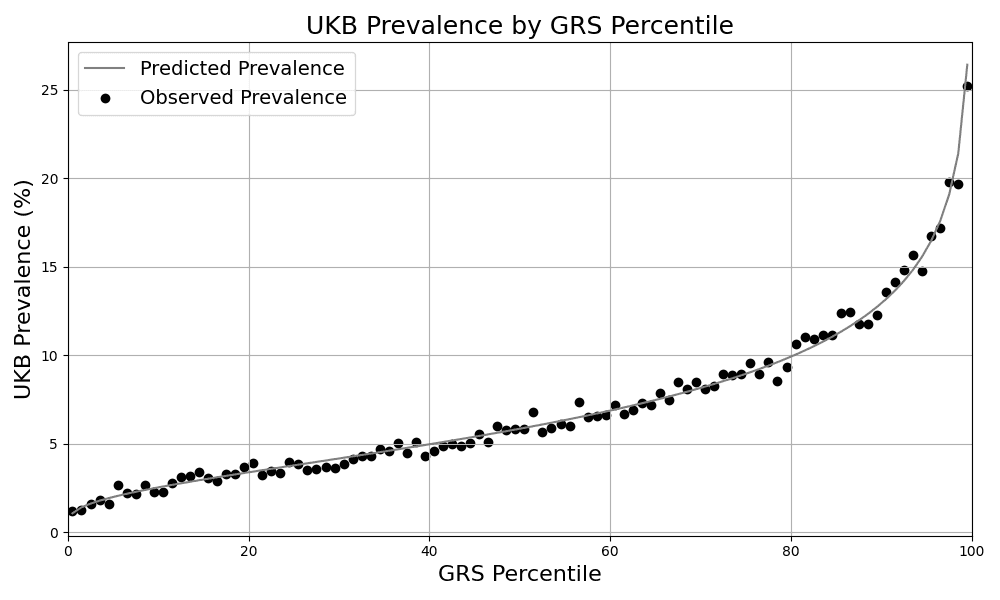
Table 1 shows the CAD observed prevalence for individuals in the UKB grouped by GRS percentile range (top 10%, 5%, and 1%), as well as how their risk compares to the baseline risk at the 50th GRS percentile. Those with higher GRS relative to the population baseline also had substantially higher observed prevalence of CAD, supporting the predictive accuracy of the GRS to identify individuals with elevated risk.
| GRS Group | Observed UKB Prevalence | Odds Ratio |
|---|---|---|
| Baseline (50th percentile) | 5.83% | 1.00 |
| Top 10% | 16.66% | 3.23 |
| Top 5% | 19.30% | 3.86 |
| Top 1% | 25.27% | 5.46 |
Estimating Lifetime Risk
The average observed prevalence of CAD in the UKB was 6.8%. This is considerably lower than the lifetime prevalence in the US general population, which has been estimated to be approximately 27%.2 This is likely due in part to the fact that UKB participants tend to be healthier than the general population, which leads to lower observed disease prevalence.10 Additionally, the observed prevalence in the UKB includes people still living who could develop the disease when they are older, and so does not capture the full lifetime risk of the disease.
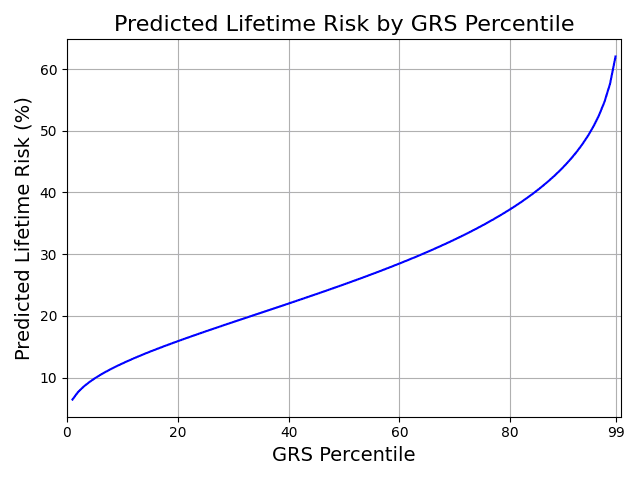
Orchid’s clinical reports include predicted lifetime disease risk, which we calculate by first estimating how disease risk varies across GRS in the UKB and then rescaling that pattern so the average matches the known lifetime population risk (Figure 2).11 People at the high end of the GRS distribution are predicted to have an elevated lifetime risk of the disease relative to the population (Table 2).
| GRS Percentile | Predicted Lifetime Risk | Relative Risk |
|---|---|---|
| 50th (baseline) | 25.10% | 1.00x |
| 95th | 50.69% | 2.02x |
| 97th | 54.69% | 2.18x |
| 99th | 62.05% | 2.47x |
Conclusion
In this study, we evaluated our CAD GRS on data from the UKB. We found that it performed well, particularly for identifying individuals with elevated risk of the disease relative to the population. In our embryo and couple reports, we adjust the model to predict lifetime risk, which is generally higher than observed prevalence in the UKB. The CAD GRS model is available to individuals of all ancestry groups.
Acknowledgments
This research was conducted using the UK Biobank Resource under Application Number 80545.
References
- P. Libby, J. E. Buring, L. Badimon, et al. Atherosclerosis. Nature Reviews Disease Primers, 5:56, 2019. doi:10.1038/s41572-019-0106-z.
- N. R. Hasbani, S. Ligthart, M. R. Brown, et al. American Heart Association’s Life’s Simple 7: lifestyle recommendations, polygenic risk, and lifetime risk of coronary heart disease. Circulation, 145(11):808–818, 2022. doi:10.1161/CIRCULATIONAHA.121.053730.
- S. Moore, I. Davidson, J. Anomaly, et al. Development and validation of polygenic scores for within-family prediction of disease risks. medRxiv, 2025. doi:10.1101/2025.08.06.25333145.
- S. Cordogan, D. B. Starr, N. R. Treff, et al. Within- and between-family validation of nine polygenic risk scores developed in 1.5 million individuals: implications for IVF, embryo selection, and reduction in lifetime disease risk. medRxiv, 2025. doi:10.1101/2025.10.24.25338613.
- Z. Zheng, S. Liu, J. Sidorenko, et al. Leveraging functional genomic annotations and genome coverage to improve polygenic prediction of complex traits within and between ancestries. Nature Genetics, 56:767–777, 2024. doi:10.1038/s41588-024-01704-y.
- FinnGen. FinnGen+MVP+UKBB Summary Statistics. https://mvp-ukbb.finngen.fi/about. Accessed: 2025-12-05.
- FinnGen. FinnGen+MVP+UKBB Phenotypes. https://mvp-ukbb.finngen.fi. Accessed: 2025-12-15.
- F. Privé et al. Portability of 245 polygenic scores when derived from the UK Biobank and applied to 9 ancestry groups from the same cohort. American Journal of Human Genetics, 109(1):12–23, 2022. doi:10.1016/j.ajhg.2021.11.008.
- C. Sudlow, J. Gallacher, N. Allen, et al. UK Biobank: an open access resource for identifying the causes of a wide range of complex diseases of middle and old age. PLoS Medicine, 12(3):e1001779, 2015. doi:10.1371/journal.pmed.1001779.
- A. Fry, T. J. Littlejohns, C. Sudlow, et al. Comparison of sociodemographic and health-related characteristics of UK Biobank participants with those of the general population. American Journal of Epidemiology, 186:1026–1034, 2017. doi:10.1093/aje/kwx246.
- N. Chatterjee, J. Shi, M. García-Closas, et al. Developing and evaluating polygenic risk prediction models for stratified disease prevention. Nature Reviews Genetics, 17:392–406, 2016. doi:10.1038/nrg.2016.27.
PDF — embedded for reading
Download PDF