Introduction
Melanoma is a cancer that develops in melanocytes, the cells that produce melanin, the pigment that gives skin its color. It is more likely than other types of skin cancer to invade nearby tissue and spread to other parts of the body.1 According to the National Cancer Institute, approximately 2.2% of people will be diagnosed with melanoma during their lifetime.2 Risk factors include fair skin that burns easily, exposure to natural or artificial sunlight, a history of blistering sunburns, and having many moles.1 Early detection is important because most melanomas are diagnosed while still localized, and five-year relative survival is approximately 100% for localized disease but 34% for disease that has spread to distant sites.2
Genetic Risk Score
Melanoma is shaped by both environmental and genetic factors. Some rare monogenic variants such as pathogenic variants in CDKN2A or CDK4 are known to substantially increase the risk of melanoma, but most cases arise from the combined effects of many genetic variants and environmental exposures.3,4 A minority of individuals carry a pathogenic variant in one of these genes. For these individuals, the single pathogenic variant is the most important factor in determining their risk of melanoma. For the large majority of individuals who do not carry one of these rare pathogenic variants, the risk of melanoma can be modeled by building a genetic risk score (GRS) which combines the small effects of many variants into a single score. Although not diagnostic, a GRS can indicate how likely an individual is to experience this disease compared to the population baseline risk.
The melanoma GRS was developed using data from five sources: the cutaneous melanoma case-control cohort of Landi et al. 2020, for which we computed summary statistics from the individual-level genotype data deposited in dbGaP under accession phs001868 (rather than using the published Landi et al. summary statistics, which include UKB participants),4 the FinnGen study,5 the Million Veteran Program,6 the All of Us Research Program, for which we generated GWAS summary statistics,7 and the UK Biobank (UKB).8 For the UKB, a subset of individuals was held out to use in the validation study, and the training portion was restricted to individuals of European ancestry. Summary statistics were generated for the UKB using REGENIE.9 Summary statistics for all five studies were then meta-analyzed using METAL.10 The final GRS was trained using SBayesRC and includes over 7 million variants.11
Orchid considers a GRS meaningfully predictive if individuals at approximately the 97.7th percentile have an odds ratio (OR) of at least 2. The melanoma GRS meets this criterion for individuals of European ancestry. Because the UKB contains too few melanoma cases of non-European ancestry to validate the GRS in other ancestry groups, the melanoma GRS is currently offered only to individuals of European ancestry.
Evaluation on UK Biobank Data
We evaluated the predictive accuracy of Orchid’s melanoma GRS using the UK Biobank (UKB), a research database of roughly 500,000 genotyped individuals from the United Kingdom.8 Because some data from the UKB was used to train the GRS, our validation study included only the set of samples that were held out for testing and not included in the GRS training. We restricted the analysis to individuals of British ancestry and defined melanoma cases as any record of ICD-10 code C43 (malignant melanoma of skin) in the UKB cancer registry (field 40006). Individuals whose only record of melanoma was a self-report (code 1059 in field 20001) were excluded from the evaluation set rather than counted as controls. This yielded 790 cases and 80,269 controls (1.0% prevalence). We then grouped individuals by GRS percentile and compared the observed melanoma prevalence within each group to our model’s predictions (Figure 1).
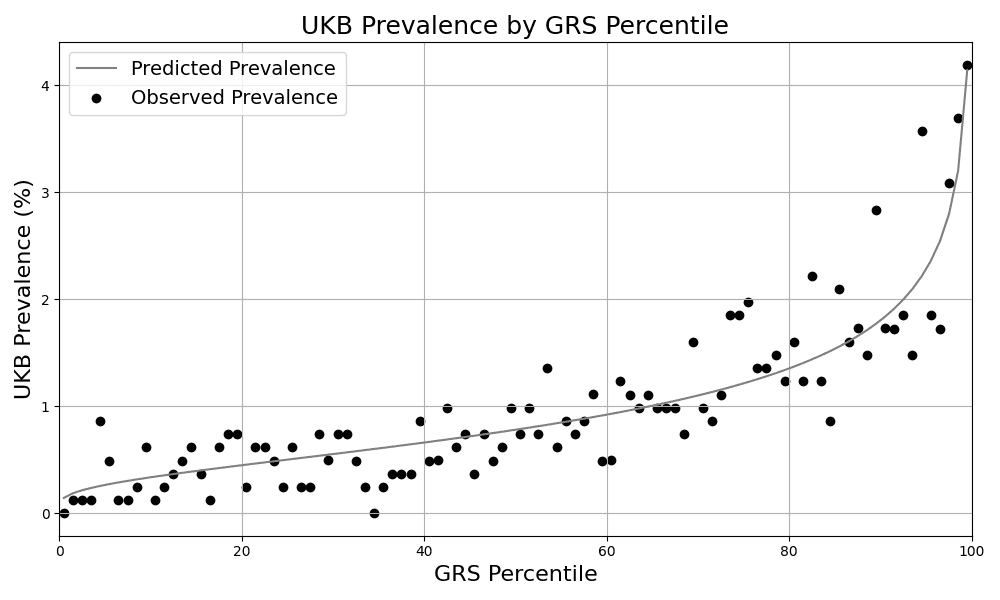
Table 1 shows the melanoma observed prevalence for individuals in the UKB grouped by GRS percentile range (top 10%, 5%, and 1%), as well as how their risk compares to the baseline risk at the 50th GRS percentile. Those with higher GRS relative to the population baseline also had substantially higher observed prevalence of melanoma, supporting the predictive accuracy of the GRS to identify individuals with elevated risk.
| GRS Group | Observed UKB Prevalence | Odds Ratio |
|---|---|---|
| Baseline (50th percentile) | 0.86% | 1.00 |
| Top 10% | 2.49% | 2.94 |
| Top 5% | 2.91% | 3.44 |
| Top 1% | 4.19% | 5.03 |
Estimating Lifetime Risk
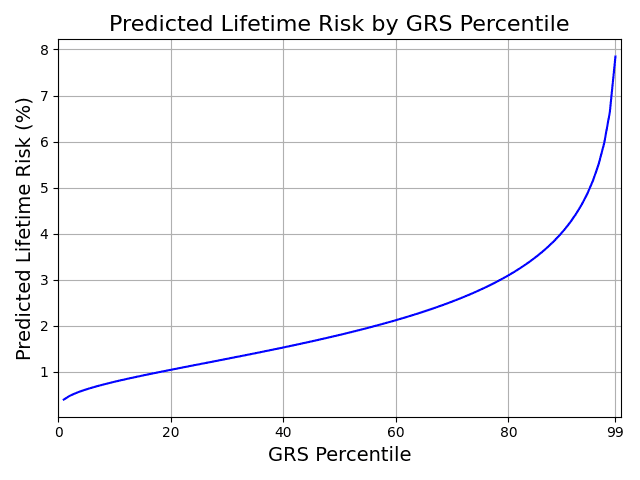
According to the National Cancer Institute, approximately 2.2% of people will be diagnosed with melanoma during their lifetime,2 higher than the observed prevalence of 1.0% in the UKB testing set. We adjust our model so that its average prevalence aligns with the National Cancer Institute estimate (Figure 2).12 People at the high end of the GRS distribution are predicted to have an elevated risk of melanoma relative to the population (Table 2).
| GRS Percentile | Predicted Lifetime Risk | Relative Risk |
|---|---|---|
| 50th (baseline) | 1.80% | 1.00x |
| 95th | 5.15% | 2.87x |
| 97th | 5.97% | 3.32x |
| 99th | 7.85% | 4.37x |
Conclusion
In this study, we evaluated our melanoma GRS on data from the UKB. We found that it performed well, particularly for identifying individuals with elevated risk of melanoma relative to the population. In our embryo and couple reports, we adjust the model to predict risk consistent with the prevalence estimated by the National Cancer Institute.2 The melanoma GRS model is currently only available to individuals of European ancestry, due to limited data availability for validation in other ancestry groups, although research efforts are underway to address this issue.
Acknowledgments
This research was conducted using the UK Biobank Resource under Application Number 80545 and data from the All of Us Research Program. We gratefully acknowledge UK Biobank and All of Us participants for their contributions, without whom this research would not have been possible.
References
- U.S. National Cancer Institute. Melanoma Treatment (PDQ) – Patient Version, 2025. Accessed 2026. URL: https://www.cancer.gov/types/skin/patient/melanoma-treatment-pdq.
- U.S. National Cancer Institute. Melanoma of the Skin — Cancer Stat Facts, 2026. URL: https://seer.cancer.gov/statfacts/html/melan.html.
- U.S. National Cancer Institute. Genetics of Skin Cancer (PDQ) – Health Professional Version, 2025. Accessed 2026. URL: https://www.cancer.gov/types/skin/hp/skin-genetics-pdq.
- M.T. Landi, D.T. Bishop, S. MacGregor, et al. Genome-wide association meta-analyses combining multiple risk phenotypes provide insights into the genetic architecture of cutaneous melanoma susceptibility. Nature Genetics, 52(5):494–504, 2020. doi:10.1038/s41588-020-0611-8.
- M.I. Kurki, J. Karjalainen, P. Palta, et al. FinnGen provides genetic insights from a well-phenotyped isolated population. Nature, 613(7944):508–518, 2023. doi:10.1038/s41586-022-05473-8.
- A. Verma, J.E. Huffman, A. Rodriguez, et al. Diversity and scale: Genetic architecture of 2068 traits in the VA Million Veteran Program. Science, 385(6706):eadj1182, 2024. doi:10.1126/science.adj1182.
- All of Us Research Program Genomics Investigators. Genomic data in the All of Us Research Program. Nature, 627(8003):340–346, 2024. doi:10.1038/s41586-023-06957-x.
- C. Sudlow, J. Gallacher, N. Allen, et al. UK Biobank: an open access resource for identifying the causes of a wide range of complex diseases of middle and old age. PLoS Medicine, 12(3):e1001779, 2015. doi:10.1371/journal.pmed.1001779.
- J. Mbatchou, L. Barnard, J. Backman, et al. Computationally efficient whole-genome regression for quantitative and binary traits. Nature Genetics, 53:1097–1103, 2021. doi:10.1038/s41588-021-00870-7.
- C.J. Willer, Y. Li, and G.R. Abecasis. METAL: fast and efficient meta-analysis of genomewide association scans. Bioinformatics, 26(17):2190–2191, 2010. doi:10.1093/bioinformatics/btq340.
- Z. Zheng, S. Liu, J. Sidorenko, et al. Leveraging functional genomic annotations and genome coverage to improve polygenic prediction of complex traits within and between ancestries. Nature Genetics, 56(5):767–777, 2024. doi:10.1038/s41588-024-01704-y.
- N. Chatterjee, J. Shi, and M. García-Closas. Developing and evaluating polygenic risk prediction models for stratified disease prevention. Nature Reviews Genetics, 17(7):392–406, 2016. doi:10.1038/nrg.2016.27.
PDF — embedded for reading
Download PDF