
Introduction
Schizophrenia is a severe and often debilitating long-term psychiatric condition, characterized by persistent cognitive deficits, frequent hallucinations and/or delusions, and social withdrawal.1 The NIH notes that the symptoms of schizophrenia generally fall into three main categories: psychotic symptoms (such as hallucinations and delusions), negative symptoms (including reduced motivation and loss of interest), and cognitive symptoms (such as difficulty focusing or retaining information).2
The lifetime prevalence of schizophrenia is approximately 0.9%.3 People with schizophrenia have an average life expectancy that is about 10–25 years shorter than that of the general population, with elevated suicide risk and other health factors contributing to this gap.4 Treatment of schizophrenia primarily involves antipsychotic medications combined with social support, although many patients continue to experience residual symptoms and functional deficits.2
Genetic Risk Score
Risk for schizophrenia is shaped partly by genetic factors.5 Monogenic testing is not available because no single gene causes the condition. Genetic risk scores (GRS), which combine the small effects of many variants into a single score, are currently the only way to estimate genetic risk. Although not diagnostic, a GRS can indicate how likely an individual is to develop the disease compared to the population baseline risk.
The schizophrenia GRS included in Orchid's reports was sourced from the PGS Catalog, an open database of published GRS models, and contains more than 900,000 variants.6,7 Risk predictions are adjusted to each individual's ancestry, with predictive power decaying as genetic distance from the predominantly European training data increases.8 Orchid considers a GRS meaningfully predictive if individuals at approximately the 97.7th percentile have an odds ratio (OR) of at least 2. The schizophrenia GRS meets this criterion for all common ancestry groups.
Evaluation on UK Biobank Data
We evaluated the predictive accuracy of Orchid's schizophrenia GRS using the UK Biobank (UKB), a research database of roughly 500,000 genotyped individuals from the United Kingdom.9 We restricted the analysis to individuals of British ancestry and defined schizophrenia using the F20 ICD-10 code, yielding 744 cases and 407,776 controls (0.18% prevalence). We then grouped individuals by GRS percentile and compared the observed disease prevalence within each group to our model's predictions (Figure 1).
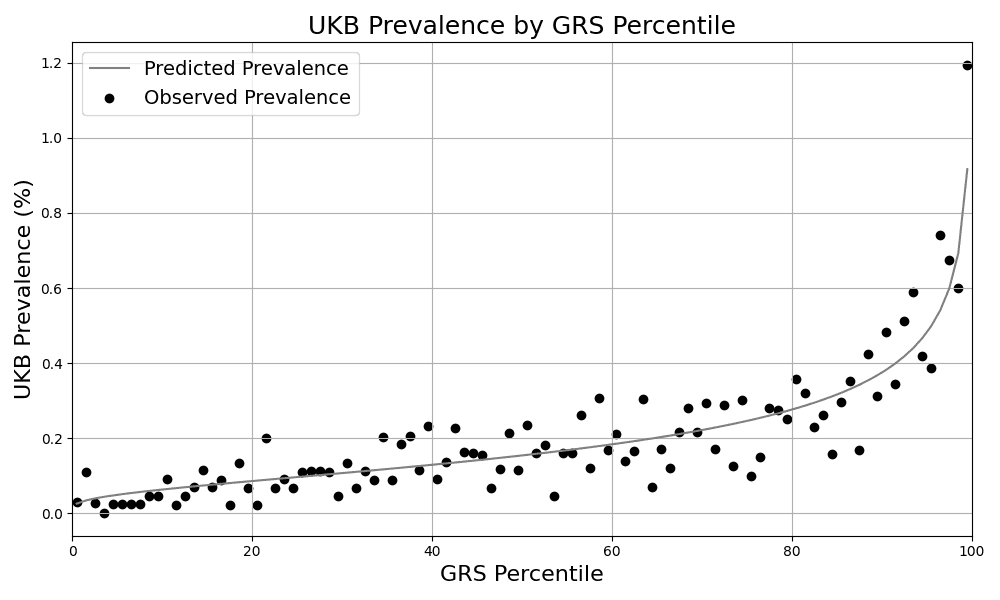
Table 1 shows the schizophrenia observed prevalence for individuals in the UKB grouped by GRS percentile range (top 10%, 5%, and 1%), as well as how their risk compares to the baseline risk at the 50th GRS percentile. Those with higher GRS relative to the population baseline also had substantially higher observed prevalence of schizophrenia, supporting the predictive accuracy of the GRS to identify individuals with elevated risk.
| GRS Group | Observed UKB Prevalence | Odds Ratio |
|---|---|---|
| Baseline (50th percentile) | 0.17% | 1.00 |
| Top 10% | 0.57% | 3.30 |
| Top 5% | 0.70% | 4.01 |
| Top 1% | 1.20% | 6.93 |
Estimating Lifetime Risk
The average observed prevalence of schizophrenia in the UKB was 0.18%. This is considerably lower than the lifetime prevalence, which has been estimated to be approximately 0.9%.3 This is likely due in part to the fact that UKB participants tend to be healthier than the general population, which leads to lower observed disease prevalence.10 Additionally, the observed prevalence in the UKB includes people still living who could develop the disease when they are older, and so does not capture the full lifetime risk of the disease.
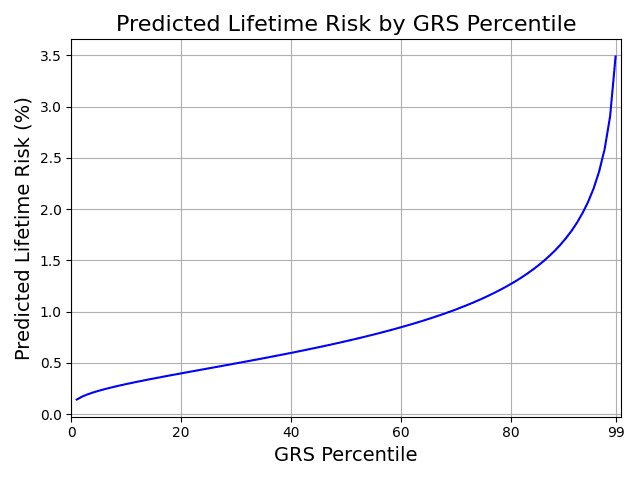
Orchid's clinical reports include predicted lifetime disease risk, which we calculate by first estimating how disease risk varies across GRS in the UKB and then rescaling that pattern so the average matches the known lifetime population risk (Figure 2).11 People at the high end of the GRS distribution are predicted to have an elevated lifetime risk of the disease relative to the population (Table 2).
| GRS Percentile | Predicted Lifetime Risk | Relative Risk |
|---|---|---|
| 50th (baseline) | 0.71% | 1.00x |
| 95th | 2.20% | 3.09x |
| 97th | 2.58% | 3.63x |
| 99th | 3.49% | 4.90x |
Conclusion
In this study, we evaluated the schizophrenia GRS on data from the UKB. We found that it performed well, particularly for identifying individuals with elevated risk of the disease relative to the population. In our embryo and couple reports, we adjust the model to predict lifetime risk, which is generally higher than observed prevalence in the UKB. The schizophrenia GRS model is available to individuals of all ancestry groups.
Acknowledgements
This research was conducted using the UK Biobank Resource under Application Number 80545.
References
- NHS. Schizophrenia – overview, April 13 2023. URL: https://www.nhs.uk/mental-health/conditions/schizophrenia/overview/.
- National Institute of Mental Health. Schizophrenia, n.d. URL: https://www.nimh.nih.gov/health/publications/schizophrenia.
- M. R. Salleh. The genetics of schizophrenia. Malaysian Journal of Medical Sciences, 11(2):3–11, 2004.
- T. M. Laursen, T. Munk-Olsen, and M. Vestergaard. Life expectancy and cardiovascular mortality in persons with schizophrenia. Current Opinion in Psychiatry, 25(2):83–88, 2012. doi:10.1097/YCO.0b013e32835035ca.
- R. Hilker, D. Helenius, B. Fagerlund, et al. Heritability of Schizophrenia and Schizophrenia Spectrum Based on the Nationwide Danish Twin Register. Biological Psychiatry, 83(6):492–498, 2018. doi:10.1016/j.biopsych.2017.08.017.
- PGS Catalog. PGS002785: SCZ_SDPR (Schizophrenia Polygenic Score). The Polygenic Score Catalog, September 29 2022. URL: https://www.pgscatalog.org/score/PGS002785/.
- Y. Gui, X. Zhou, Z. Wang, et al. Sex-specific genetic association between psychiatric disorders and cognition, behavior and brain imaging in children and adults. Translational Psychiatry, 12(1):347, 2022. doi:10.1038/s41398-022-02041-6.
- Florian Privé, Hugues Aschard, Andrey Ziyatdinov, and Michael G.B. Blum. Portability of 245 polygenic scores when derived from the UK Biobank and applied to 9 ancestry groups from the same cohort. American Journal of Human Genetics, 109(1):12–23, 2022. doi:10.1016/j.ajhg.2021.11.008.
- C. Sudlow, J. Gallacher, N. Allen, et al. UK Biobank: an open access resource for identifying the causes of a wide range of complex diseases of middle and old age. PLoS Medicine, 12(3):e1001779, 2015. doi:10.1371/journal.pmed.1001779.
- A. Fry, T.J. Littlejohns, C. Sudlow, et al. Comparison of sociodemographic and health-related characteristics of UK Biobank participants with those of the general population. American Journal of Epidemiology, 186:1026–1034, 2017. doi:10.1093/aje/kwx246.
- N. Chatterjee, J. Shi, M. García-Closas, et al. Developing and evaluating polygenic risk prediction models for stratified disease prevention. Nature Reviews Genetics, 17:392–406, 2016. doi:10.1038/nrg.2016.27.
PDF — embedded for reading
Download PDF