While the idea of using genetic information from your embryos to rank and select which embryo to transfer may sound appealing, many patients worry that the biopsy could harm their embryo. This article reviews the process of embryo biopsy and the minimal risks associated with the procedure.
Embryo biopsy has become a commonplace procedure in fertility clinics across the country over the last decade. A small sample, or biopsy, from a blastocyst embryo can be utilized for preimplantation genetic testing (PGT). Depending on your medical history and concerns, PGT can potentially be used to test embryos for chromosome imbalances that occur by random chance, monogenic diseases that may run in your family, and complex diseases like diabetes and heart disease. If you are interested in genetic testing on your embryos be sure to speak with your IVF doctor about the different options well in advance of your retrieval.
Embryo biopsy
Embryos are typically biopsied at blastocyst stage and the procedure is typically referred to as a blastocyst biopsy, or trophectoderm biopsy. A good quality embryo will usually achieve blastocysts stage on day 5 or day 6. A blastocyst stage has over 100 cells and shows two types of tissue forming:
- The trophectoderm (TE) is the outer layer of the embryo and will eventually form part of the placenta if the embryo results in a pregnancy.
- The inner cell mass (ICM) is a clump of cells in the center of the embryo and will eventually form the baby if the embryo results in a pregnancy.
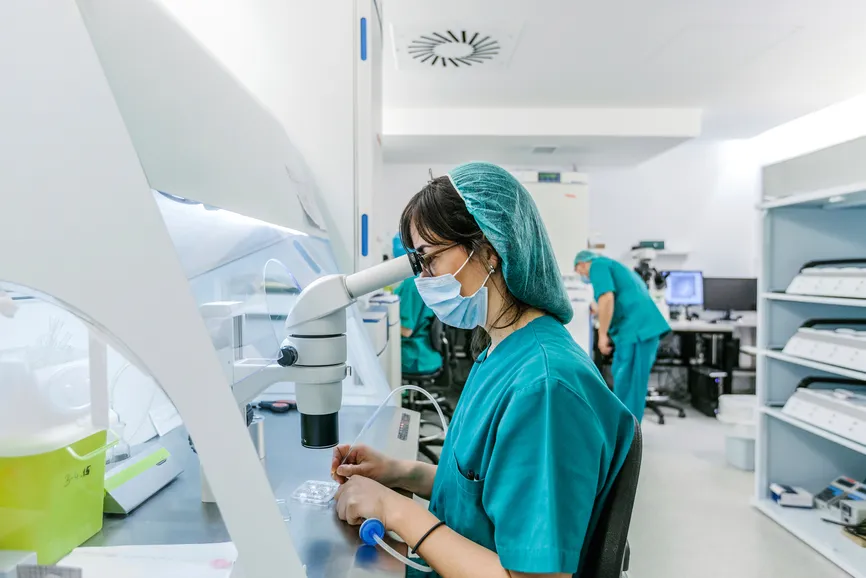
Embryo biopsy is performed by a trained embryologist in the IVF laboratory. During the procedure, about 5-10 cells are removed from the trophectoderm using a laser. After the embryo is biopsied it will be vitrified (frozen) and stored. The biopsied cells can then be used for PGT which may be performed at your clinic or at an outside laboratory. While the embryo biopsy may be shipped to a laboratory for PGT, the embryo itself will typically remain safely stored at your clinic, as there is no need to ship the embryo itself.
Will the embryo be damaged with a biopsy procedure?
Often, patients have asked me if the future baby will be harmed when the biopsy is performed. While the risk for harming the embryo is likely very low, no procedure is completely free of risk.
However, because the biopsy samples trophectoderms cells that will later become the placenta, not the inner cell mass (which later becomes the baby), the biopsy is not thought to cause an increased risk for birth defects or damage to the future baby. The vast majority of children conceived with assisted reproductive technology appear to be healthy, but ongoing studies continue to measure risks associated with assisted reproductive technologies such as biopsy.
Occasionally, an embryo stops growing after the biopsy is performed, however it is impossible to know whether this was due to the biopsy, or if it would stopped developing even without the biopsy. Your IVF clinic can likely provide you with their specific statistics regarding embryo biopsy risks. In my experience, most clinics quote between a 1-5% chance that an embryo will stop growing after the biopsy is performed. So, the vast majority of embryos survive the biopsy procedure.
When considering the risks associated with biopsy, you need to also weigh the benefits gained by testing embryos with PGT. The chances for an embryo to have a chromosome imbalance or genetic disease which could be identified with PGT are likely much greater than the risk that an embryo would be damaged with biopsy. If you have questions about risks and benefits associated with blastocyst biopsy and PGT be sure to ask your provider.