Changes in a gene called FMR1 can cause a variety of health concerns. Whether you have a known family history or are learning about this condition for the first time, it can be overwhelming to navigate all the information - this guide breaks down the need-to-know points for Fragile X Syndrome and family building.
Please note: this is intended to be a general informational guide only - for personalized counseling on your results and associated risks, ask your doctor for a referral to a comprehensive preconception genetic counselor.
What are FMR1-Related Disorders
Fragile X Syndrome (FXS): one the most common inherited forms of autism and intellectual disability in children. This genetic condition causes challenges with learning, behavior, and development, and primarily affects males, although females may also be less severely impacted. Other features can include distinctive facial features, poor muscle tone, scoliosis, and heart problems. This occurs when someone has a full mutation.
Fragile X Associated Tremor and Ataxia Syndrome (FXTAS): adult-onset neurological condition that causes symptoms similar to Parksinon’s Disease, including tremors, balance issues, and memory problems. People who are premutation carriers are at risk for this condition and male carriers are more likely to have symptoms than female carriers (40% vs 20%).
Fragile X Associated Primary Ovarian Insufficiency (FXPOI): irregular menstrual cycles and premature menopause which can impact fertility. Affects ~20% of women who are premutation carriers.
What Causes Fragile X Syndrome
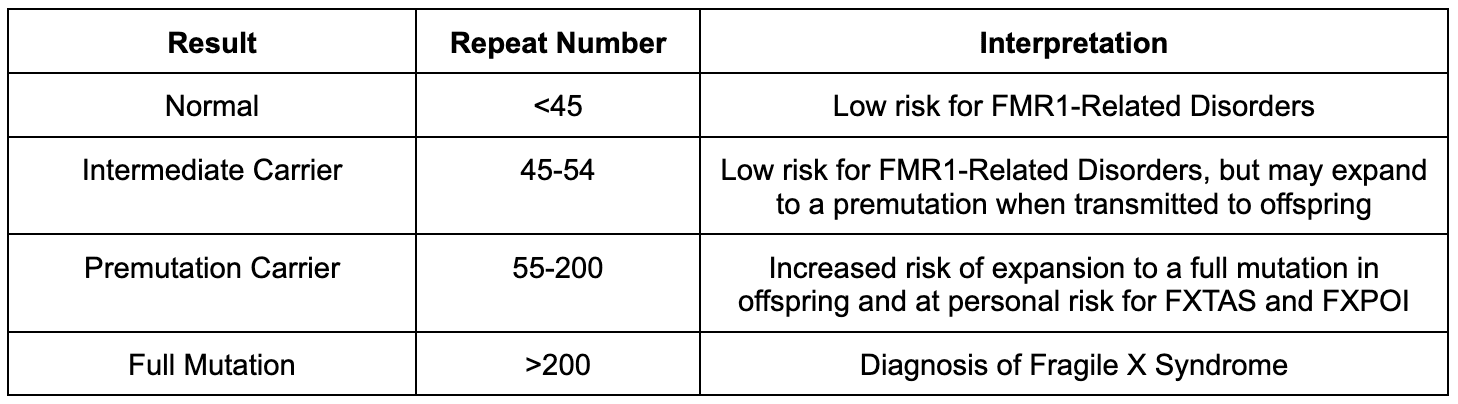
A change in a gene called “FMR1” is responsible for causing Fragile X Syndrome. When working correctly, this gene helps with brain development. There are three letters - CGG - that are repeated dozens of times throughout this gene. These repeats can ‘slip’ and expand when passed down through generations, interfering with the gene’s function. The number of repeat expansions within the gene determine the health risks:
Why Does this Affect Boys More than Girls
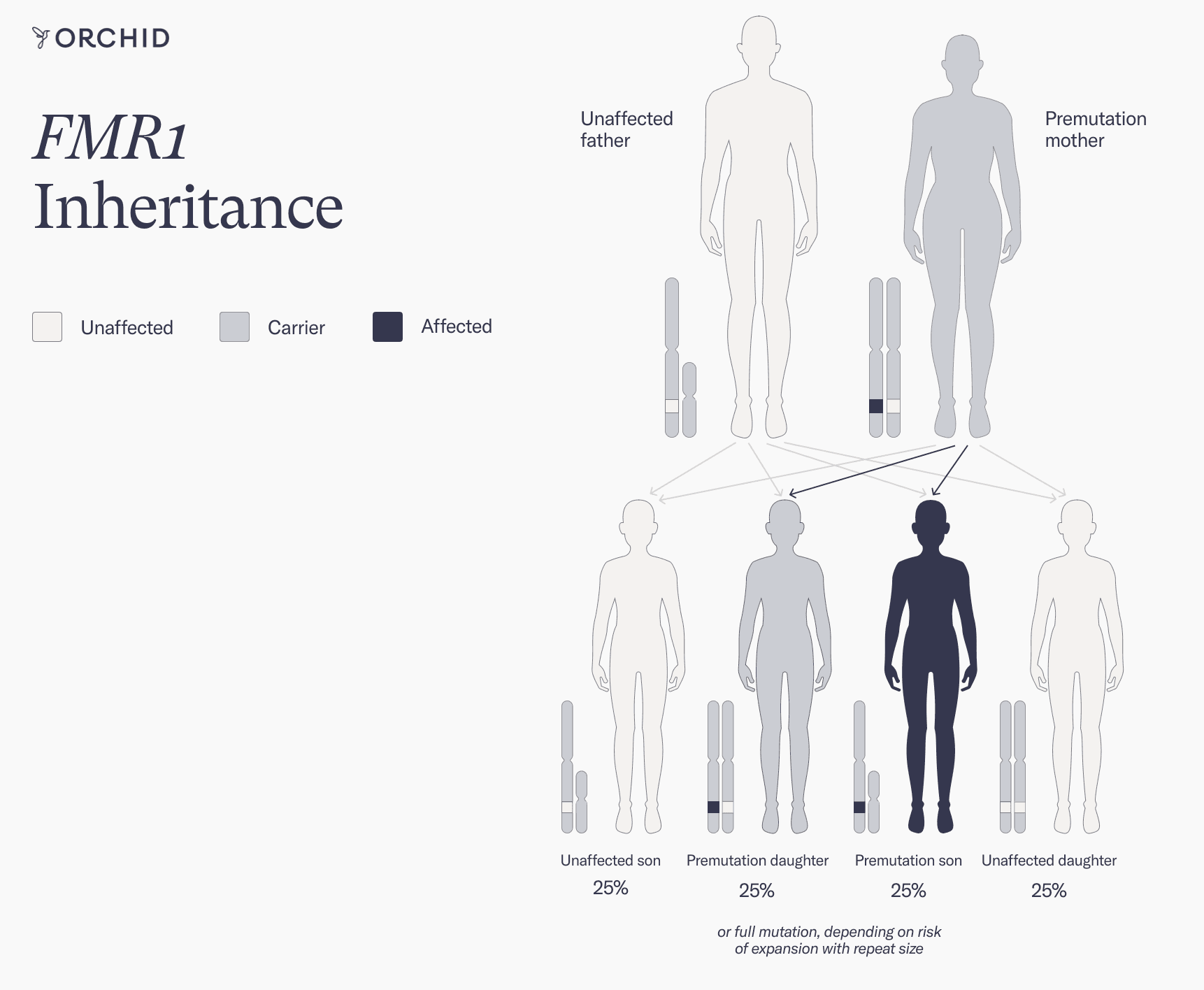
The FMR1 gene is located on one of the sex chromosomes - females typically have 2 X chromosomes, and males have an X and a Y. Because females have two copies of the FMR1 gene, their back up copy is often enough to mitigate or avoid symptoms. Males have only one copy, therefore are more likely to be affected if the gene isn’t working.
How Do I Know if I’m at Risk for Fragile X Syndrome
Fragile X Syndrome is included on most standard carrier screens (genetic tests designed to identify reproductive risks) for women. Talk to your IVF provider or OB/GYN to learn more about how you can access carrier screening.
I’m a Carrier for Fragile X Syndrome - What’s my Risk for Having a Child with FXS
If one of your two X chromosomes has an FMR1 premutation (55-200 CGG repeats), there is a 50% chance for each embryo/pregnancy to inherit the premutation. The risk of this causing Fragile X Syndrome depends on a few things:
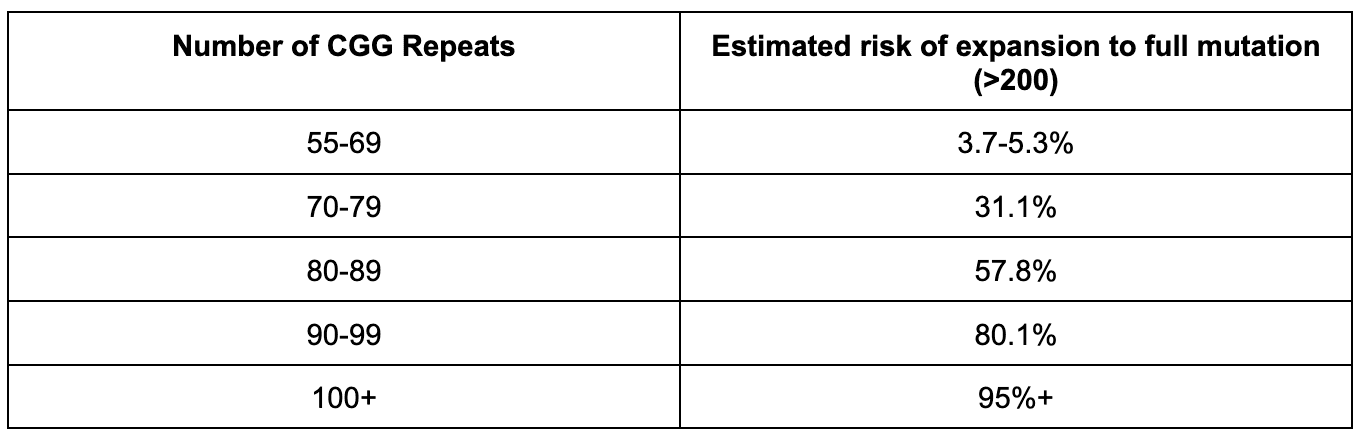
1. How many CGG repeats you have: generally, the higher the number of repeats, the more likely they are to expand to over 200. Check your results for your specific risk.
2. How many AGG interruptions you have: some carrier screening will include analysis of how many AGG ‘interruptions’ exist within the permutation. These three letters intersperse the CGG repeats and act as ‘anchors’ to decrease the risk of expansion - typical results will show that a premutation will have between 0 and 4 AGG interruptions with higher numbers corresponding to a lower chance of a full mutation in offspring. Check your results for your specific risk.
3. The sex of the embryo/pregnancy: As an X-linked condition, the implications of a positive test result depend on sex, with males more likely to experience more severe symptoms of a full mutation and the health risks of a premutation varying for males and females as well (see “What are FMR1-Related Disorders?” above).
Is Embryo Screening for Fragile X Syndrome Available
Yes! Orchid’s whole genome embryo screening provides a simplified option for targeted FMR1 screening for families known to be at risk for Fragile X Syndrome. This screening is available for known Premutation and Intermediate carriers and tells you how many CGG repeats each embryo has*, allowing you to prioritize embryos with the lowest risk for a full mutation.
*Please note, results will be reported as a single CGG number per allele, however variances of 3 CGG repeats for repeat ranges <70, +/- 5 CGG repeat ranges of 71 - 120, and +/- 9 CGG repeats for >121 may occur
How Does Orchid’s Fragile X Screening Differ from Traditional PGT-M
- No family member testing or saliva samples required (aside from egg and sperm source)
- No custom probe development = faster timeline to results and streamlined process
- Simultaneous comprehensive reporting of other clinically significant conditions
Ready to Get Started
Reach our board-certified genetic counselors at genetics@orchidhealth.com with a copy of your Fragile X carrier screening results and they’ll advise on next steps to get set up!
REFERENCES:
Hunter JE, Berry-Kravis E, Hipp H, et al. FMR1 Disorders. 1998 Jun 16 [Updated 2024 May 16]. In: Adam MP, Feldman J, Mirzaa GM, et al., editors. GeneReviews® [Internet]. Seattle (WA): University of Washington, Seattle; 1993-2025. Available from: https://www.ncbi.nlm.nih.gov/books/NBK1384/
National Fragile X Foundation. (2025). Fragile X syndrome. Retrieved August 25, 2025, from https://fragilex.org/fxs/about/
Nolin SL, Sah S, Glicksman A, Sherman SL, Allen E, Berry-Kravis E, Tassone F, Yrigollen C, Cronister A, Jodah M, Ersalesi N, Dobkin C, Brown WT, Shroff R, Latham GJ, Hadd AG. Fragile X AGG analysis provides new risk predictions for 45–69 repeat alleles. Am J Med Genet Part A. 2013;161A:771–8.
Nolin, S. L., Glicksman, A., Tortora, N., Allen, E., Macpherson, J., Mila, M., Vianna-Morgante, A. M., Sher, A. L., & Dobkin, C. (2015). Fragile X full mutation expansions are inhibited by one or more AGG interruptions in premutation carriers. Genetics in Medicine, 17(5), 358–364. https://doi.org/10.1038/gim.2014.106